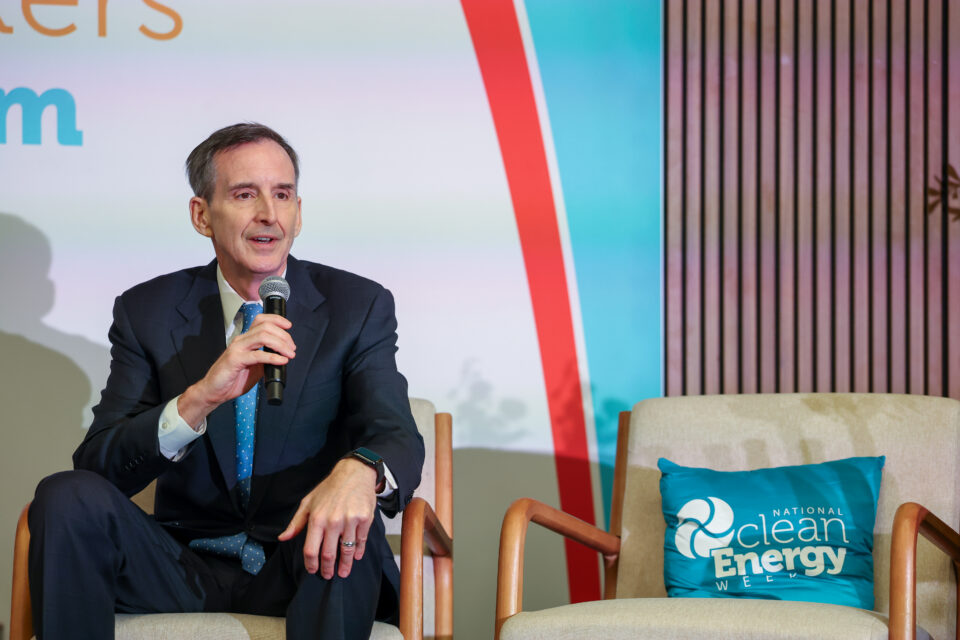
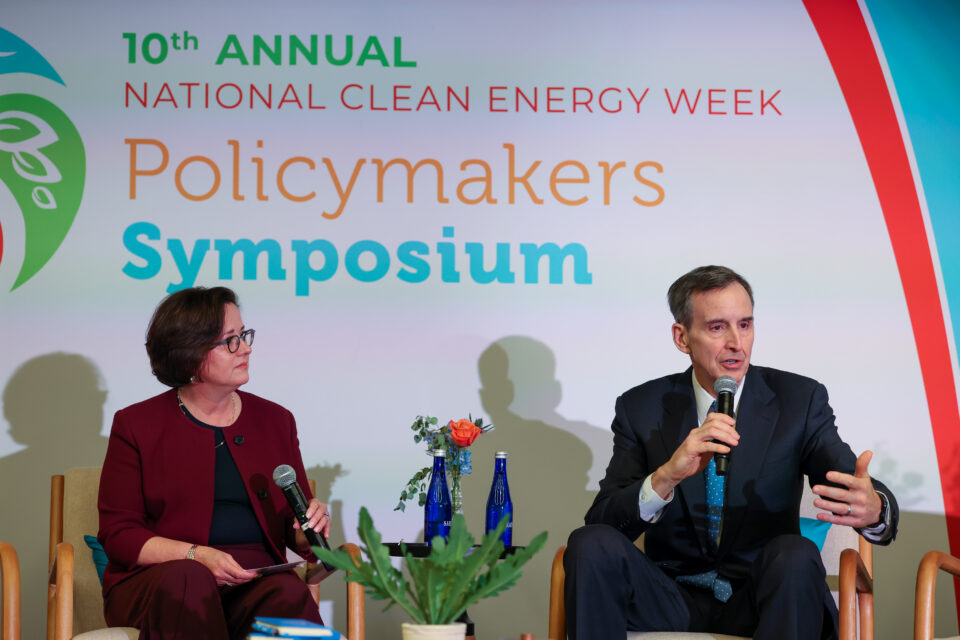
At the 10th annual National Clean Energy Week, the Solar Energy Industries Association (SEIA) brought the Policymakers Symposium an argument grounded in cost, reliability and national security. Tim Pawlenty, former two-term Minnesota governor and now SEIA’s president and chief executive officer, did so in an armchair conversation moderated by Kelley Robertson, a partner at PLUS Communications, covering the industry’s changing economics and what it now asks of Washington.
Solar’s Share of New Generation
Robertson opened by pointing to solar’s growth, from roughly 1% of the national energy mix a decade ago to a projected share near 10% by 2027. Pawlenty added on, citing the Solar Market Insight Report, which found solar and battery storage accounted for 70% of all new electricity-generating capacity in the first half of 2026.
He urged the industry to “update the solar and storage story.” The outdated story is one policymakers still tell about solar being expensive, unreliable and slow to build, and he argued the numbers answered all three objections years ago.
Cost, Duration and Speed
Three arguments reinforced his case. On cost, Pawlenty cited nonpartisan analysis from the investment bank Lazard calling solar the most cost-effective source available. On reliability, he pointed to the batteries built alongside solar projects, whose duration moved from two hours to four, six and eight, with ten within reach, which he said has largely resolved solar’s intermittency objection. On speed, he calculated solar’s timeline from concept to generation at 24 months, against three to ten years or longer for other technologies.
What Republican Voters Think
The conversation continued with Robertson asking Pawlenty what policymakers misunderstand about Republican voters and solar power. He pointed to surveys showing substantial Republican majorities favoring more deployment once they learn how the costs compare, and he maintained the economics stand apart from the climate debate. CRES Forum’s own polling, released during the 2026 symposium, found 71% of voters describe making renewable energy a bigger part of the energy supply as the right direction, including 68% of Republicans.
Supply and National Security
Robertson noted the question of what should power the grid has long been framed as solar against natural gas, and asked whether it’s still a valid frame. Pawlenty rejected the premise because demand is climbing faster than every energy source combined can currently meet, and he characterized SEIA’s position as all-of-the-above. When asked how the sector insulates consumers from oil price swings tied to the Strait of Hormuz conflict, he answered, “Iran can’t block the sun that I know of.” Domestic generation, he explained, helps untether American energy policy from hostile suppliers.
Technology Neutrality and Local Opposition
On permitting, Pawlenty said SEIA members seek no preferential treatment. This built on the demand picture he described earlier: with consumption climbing faster than every source combined can meet, SEIA argues for an all-of-the-above approach rather than one pitting technologies against each other. “Just set some rules, make it tech neutral so everybody plays on a fair playing field,” he said, warning against revising the framework every two or three years, since developers commit capital over far longer time horizons. Other technologies share the interest, because a future administration could place any of them in what he called the penalty box. Neutral rules protect every source from that outcome, solar included.
On local opposition, he listed the commitments a project should be prepared to make: no increase in local energy prices, no net draw on local water, a contribution beyond temporary construction jobs and a presence after construction ends.
Conclusion
The closing question invited anything the session had missed, and Pawlenty made an argument for optimism. Technology has improved, price points have fallen, reliable supply has grown over the past decade and public appetite for more generation is evident in the polling. The sector’s ask of Washington is narrower: consistent rules applied evenly across technologies and left in place long enough for projects to be financed and built.