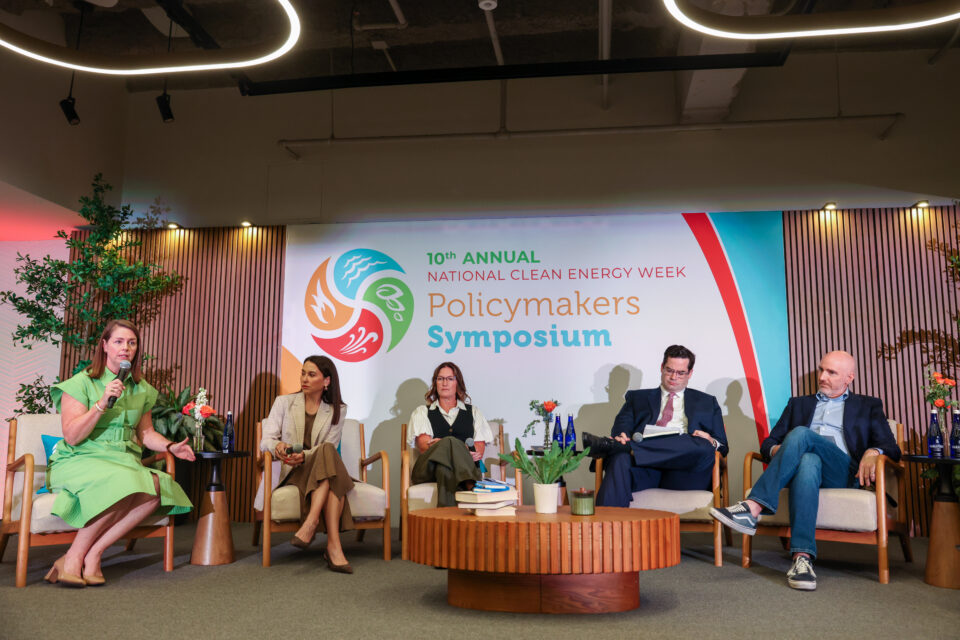
At the 10th annual National Clean Energy Week, permitting reform was a recurring theme throughout the two-day Policymakers Symposium. One panel, moderated by Alex Flint, executive director of the Climate Solutions Foundation, gathered leading voices in the energy industry and public polling for an insider’s view of the discussions underway in Congress.
The panel was made up of experts with years of experience in Washington: Amy Andryszak, president and CEO of the Interstate Natural Gas Association of America (INGAA); Liz Bowman, vice president of government affairs and outreach at Williams, and member of the Partnership to Address Global Emissions (PAGE); Debra Phillips, president and CEO of the National Electrical Manufacturers Association (NEMA); Richard England, vice president of government affairs at the Corporate Energy Buyers Association (CEBA) and Alex Lundry, president of Redbud Consulting.
Projected Demand and the Infrastructure Gap
Andryszak opened with the North American Midstream Infrastructure Report, published by the INGAA Foundation. Modeling energy needs 25 years out, the report finds that North America will require between 44% and 55% more power than it did in 2022. Meeting that demand will take $1 trillion in additional midstream infrastructure, roughly three-quarters of it tied to the natural gas value chain.
Building on that, Bowman described an existing infrastructure gap, explaining while demand for natural gas has grown more than 55% over the past decade, the infrastructure to deliver it has grown only 27% and the storage to hold it has grown 4%.
The challenge extends beyond the equipment required to move electricity. Phillips with NEMA, whose members manufacture the wires, transformers and switch gear that carry electrons to consumers, said those companies have invested roughly $200 billion in American manufacturing since 2018 and still face multi-year backlogs on core equipment.
Permitting Timelines and Permit Certainty
Bowman returned with the sharpest illustration of where project delays occur, noting it takes her company less than a year to build a long-haul pipeline, but roughly four years to secure the permits that allow construction to begin.
England with CEBA, drew a distinction between permit certainty and permit neutrality. He argued certainty means once an agency issues a permit, it sticks and cannot later be revoked, because one that can be rescinded later amounts to little more than a “half promise,” while neutrality means projects are judged on the same terms no matter what they are building. Having lobbied for oil under a Democratic president and offshore wind under a Republican one, England said he has watched projects attacked for falling out of favor with whichever administration happens to hold power, and he argued that the resulting pendulum is no way to run a government and no way to invest capital in a country seeking to expand domestic energy production and accelerate infrastructure development.
NEPA, Clean Water Act and Transmission
When asked what the Senate negotiators should be prioritizing, Andryszak named a core package: statutory changes to the National Environmental Policy Act (NEPA), revisions to Clean Water Act Section 401 permits, judicial reform and permit certainty written into statute. She added transmission reform as a fifth pillar, while noting it falls outside INGAA’s primary focus.
Bowman supplied what that certainty would have to mean in practice, arguing that courts should not vacate a permit an agency has already issued on procedural NEPA grounds.
Phillips agreed those were the right issues, but said no comprehensive measure works without transmission. She noted NEMA supported this year’s narrower attempts, including the REWIRE Act (S.3947), the High-Capacity Grid Act (H.R. 6633) and the SPEED Act (H.R. 4776).

Polling and Public Opinion on Permitting
Lundry with Redbud offered data from polling conducted for Centerline Liberties and CRES Forum, and the picture it paints is of public support for permitting reform that holds until it is tested. Voters were asked whether permitting energy projects should be easier or harder; 40% favored easier while 24% favored harder. Once both sides are argued, 60% choose a careful, thorough review over a faster process.
Framing moves it further. In a split-sample experiment, adding data centers and AI to the question increased resistance by 11 points. What tested strongest ran the other way, toward the local and concrete: the jobs construction brings into a community, electricians, welders and linemen, followed by the argument that red tape means higher electric bills.
One finding spoke to the week itself. Lundry also found that significant renewable generation sits stuck in the permitting line, which 52% of voters called an extremely or very convincing reason to support reform.
Conclusion
In the closing round, when asked what the coming months require, the panel was optimistic. Panelists pointed to a coalition that now spans traditional energy, clean energy and the broader business community and to a shared agreement that something has to change, and fast. The advice to the room was to press members of Congress directly rather than rehearse the policy arguments again.